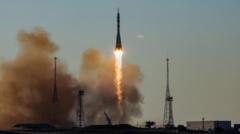
A Soyuz spacecraft launched from Kazakhstan carrying three crew members bound for the International Space Station. NASA astronaut Anil Menon and Russian cosmonauts Pyotr Dubrov and Anna Kikina lifted off for an eight-month mission aboard the orbiting laboratory.
The launch marks another rotation of ISS personnel, maintaining continuous human presence on the station. Menon, Dubrov, and Kikina will join the existing crew already stationed in orbit, where they'll conduct scientific research, perform maintenance operations, and oversee experiments across multiple disciplines including biology, materials science, and physics.
This mission continues the decades-long collaborative effort between NASA and Russia's space agency despite geopolitical tensions. The partnership has remained largely insulated from broader international disputes, with both nations treating human spaceflight as a domain requiring cooperation. Menon's selection represents NASA's ongoing commitment to diverse crew representation in its astronaut corps.
The eight-month duration is standard for ISS expeditions, allowing crews sufficient time to acclimate to microgravity, complete their research objectives, and conduct knowledge transfer with incoming crews. Upon completion, the three will return to Earth aboard another Soyuz spacecraft.
Soyuz rockets have served as the primary crew transport vehicle to the ISS since the Space Shuttle program's retirement in 2011. NASA has invested in commercial partnerships with SpaceX and Boeing to develop domestic crew vehicles, reducing reliance on Russian launch services, though Soyuz remains operational and reliable for crew rotation missions.