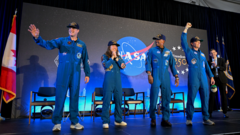
NASA's Artemis II crew held their first public appearance since splashing down last week, sharing reflections on a mission that deepened their bond. The four astronauts emphasized unity and optimism during the press conference, underscoring the camaraderie forged through months of training and the high-stakes nature of lunar exploration.
The crew's focus on friendship and team cohesion carries weight in the context of deep-space missions where psychological resilience matters as much as technical skill. Their public message signals confidence in NASA's ability to execute the Artemis program, which aims to return humans to the Moon and establish sustainable lunar operations. This comes as the space agency navigates budget constraints, technical challenges, and public scrutiny around the timeline for lunar landings.
Artemis II marks a critical stepping stone in NASA's Moon-to-Mars architecture. The mission validates the Space Launch System and Orion spacecraft hardware after years of development delays. The crew's positive framing helps maintain congressional and public support for a program that requires sustained funding across multiple administrations.
The astronauts' emphasis on hope reflects broader industry momentum. Commercial space companies continue advancing lunar cargo services, and international partners contribute to NASA's Gateway station concept. The Artemis program stands at an inflection point where crew safety, mission success, and public enthusiasm converge.
Their return strengthens the narrative around human spaceflight as both scientifically essential and deeply human. The friendship angle resonates beyond aerospace circles, reminding audiences that exploration requires trust and teamwork at the highest level.
THE TAKEAWAY: Artemis II's crew underscores that successful deep-space missions depend on both technical excellence and human connection, signaling readiness for the next phase of lunar exploration.