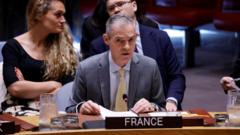
The US delegation walked out of a UN Security Council meeting as France delivered remarks, escalating tensions over Washington's decision to block the renewal of the UN High Commissioner for Human Rights position. The US voted alongside Russia and North Korea to reject extending the term, marking a stark diplomatic rupture.
France's response prompted the walkout, signaling deep displeasure with the American position. The vote reflects broader geopolitical fractures within the Security Council, where the US increasingly aligns with authoritarian regimes on human rights matters. Russia and North Korea have long opposed robust UN scrutiny of their domestic records. The US move breaks from decades of American leadership on human rights advocacy at the international level.
The High Commissioner role monitors and reports on global human rights violations, holding governments accountable for abuses. By voting against renewal, the US effectively sided with nations it typically opposes on virtually every other Security Council issue. The alignment underscores how human rights concerns have become secondary to other strategic calculations in current US foreign policy.
France, a permanent Security Council member and vocal human rights advocate, used the opportunity to voice criticism of the American position. The walkout itself demonstrated that diplomatic tensions ran high enough to abandon normal protocol. Such public exits are rare and deliberate gestures designed to register contempt.
The vote outcome likely prevents the high commissioner from continuing their mandate unless member states find an alternative path forward. This creates uncertainty for global human rights monitoring at a moment when conflicts in Ukraine, Gaza, and elsewhere generate extensive documentation needs.
The incident exposes fractures within the Western alliance on human rights priorities and signals that the Biden administration has deprioritized this traditional cornerstone of US diplomacy, regardless of the symbolic cost.