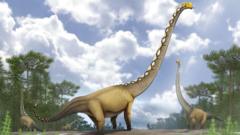
Paleontologists have identified a new sauropod species in Thailand, adding another entry to the roster of long-necked herbivores that dominated the Jurassic landscape. The creature, named Uragasaurus kalasinensis, stretched roughly 98 feet in length—about the size of a cricket pitch—and roamed what is now northeastern Thailand some 150 million years ago.
The discovery emerged from fossil fragments uncovered in the Kalasin Province, where researchers assembled skeletal remains sufficient to distinguish the species from known sauropods. Uragasaurus belongs to the titanosaur family, the lineage of colossal plant-eaters that included some of Earth's heaviest animals. The 150-million-year timeline places it squarely in the Late Jurassic period, when sauropods thrived across multiple continents.
Thailand's fossil record has yielded increasing numbers of dinosaur discoveries in recent years, positioning the country as a growing hub for paleontological research in Southeast Asia. The Kalasin Province specifically has become a hotbed for sauropod finds, suggesting the region provided ideal conditions for these herbivores during the Mesozoic era. Scientists believe the area's ancient floodplains and vegetation made it suitable habitat for massive, long-necked species that required constant feeding to sustain their enormous bulk.
The formal naming convention reflects both the discovery site and a local reference, embedding the species within its geographical context. Each new sauropod identification refines understanding of how these animals distributed themselves across prehistoric continents and evolved their defining characteristics over millions of years. Uragasaurus joins a growing catalog of Thai dinosaur species, strengthening the scientific case for the region's Mesozoic significance.