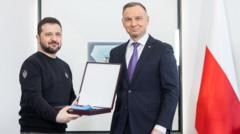
Poland's President Andrzej Duda revoked Ukraine's highest state honor from President Volodymyr Zelensky, citing the renaming of a Ukrainian military unit that previously bore a controversial World War II Polish name. The Order of the White Eagle, Poland's most prestigious decoration, was stripped from Zelensky over Ukraine's decision to rename a military formation that had carried the name of a Polish WW2-era unit with nationalist associations.
Kyiv quickly fired back, calling the move a "strategic mistake" and "disrespectful," marking a rare public rift between two Eastern European allies locked in resistance against Russian aggression. Ukraine's government signaled that the award withdrawal damaged bilateral relations at a moment when both nations needed unified front against Moscow.
The dispute centers on historical naming conventions tied to Polish military units from the interwar and World War II periods. Poland views the renaming as an erasure of shared heritage, while Ukraine asserts sovereignty over its own armed forces nomenclature and military identity. The tension reveals how wartime alliances can fracture over historical grievances and symbolic gestures.
Zelensky had received Poland's highest honor previously, reflecting Warsaw's vocal support for Ukraine throughout Russia's invasion. Poland has served as Ukraine's primary military supply corridor and diplomatic advocate. Yet the award revocation signals that Poland's nationalist government under Duda won't overlook what it perceives as disrespect toward Polish historical legacy, even from a wartime ally.
The incident underscores how historical memory remains weaponized in Eastern European politics. Both nations share complex WW2 histories intertwined with shifting borders, occupations, and competing narratives. The public spat could complicate coordination on defense matters and humanitarian corridors that remain vital to Ukraine's survival.