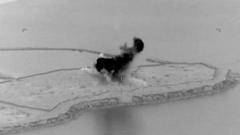
The US and Iran traded military strikes across the Persian Gulf in a sharp escalation that tested the fragile boundaries of their ongoing regional standoff. The US military conducted strikes against Iranian drones and radar installations, prompting Tehran to respond by targeting American military bases stationed in Kuwait and Bahrain.
The exchange marks the latest in a series of tit-for-tat military actions that have defined US-Iran tensions in the Gulf. Both sides have repeatedly tested each other's resolve without fully crossing into all-out conflict, maintaining a dangerous equilibrium where direct hits occur but full-scale war remains averted.
US military operations focused on Iranian unmanned aerial systems and air defense infrastructure, targeting capabilities that Tehran has used to conduct surveillance and launch attacks against American interests in the region. Iran's response struck at the heart of the US military presence in the Gulf, with ballistic missiles or drone strikes directed at bases that serve as operational hubs for American forces overseeing shipping lanes, counterterrorism operations, and regional deterrence.
The strikes underscore how quickly tensions can flare in one of the world's most contested waterways. Both powers maintain significant military assets in the region. Iran operates its Revolutionary Guard Corps Navy and aerial capabilities. The US operates from permanent bases and carrier strike groups that transit the Strait of Hormuz, through which roughly 20 percent of global oil passes.
The cycle reflects deeper strategic competition. Iran seeks to project power and constrain American military operations. The US aims to maintain freedom of navigation and protect allies like Saudi Arabia, Israel, and the Gulf states. Previous escalations in this pattern have stopped short of sustained warfare, suggesting both sides calculate the costs of full conflict as prohibitive.
Observers watched carefully to see whether either nation would escalate further or step back. The Gulf remains a tinderbox where miscalculation carries catastrophic consequences for global energy markets and regional stability.