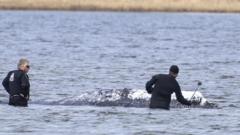
A dead sperm whale, nicknamed "Timmy" by rescuers, washed ashore in Denmark after rescue efforts failed to save the animal. The whale was discovered off the coast of Anholt island, where Danish authorities and marine specialists had spent days attempting to guide it back to open water. Despite coordinated efforts to redirect the distressed whale, it died before reaching deeper seas.
The stranded cetacean prompted an immediate response from Danish marine rescue teams, who worked to prevent further deterioration of the animal's condition. Sperm whales occasionally beach or become trapped in shallow waters due to navigation errors, illness, or disorientation from underwater sonar activity. The cause of Timmy's initial stranding remains under investigation.
Now beached, the whale will undergo a full autopsy to determine what drove it to shallow Danish waters and ultimately led to its death. Necropsy findings typically examine stomach contents, organ function, and evidence of disease or injury. Results could reveal whether the animal suffered from infection, parasites, malnutrition, or trauma that compromised its ability to survive in its natural habitat.
The incident reflects broader concerns about marine mammal welfare in northern European waters. Sperm whales rarely venture this far north into temperate regions, making Timmy's appearance noteworthy for marine biologists tracking cetacean migration patterns and health. Rising ocean temperatures and shifts in prey availability have occasionally pushed deep-diving whales toward unusual territories.
The Danish government will preserve findings from the examination for marine research databases. Such autopsies contribute to understanding whale population dynamics and early warning signs of ecosystem stress that might endanger larger cetacean communities across the North Atlantic.