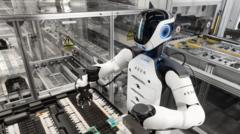
BMW has deployed humanoid robots onto its assembly line at a European manufacturing facility, escalating the automaker's automation strategy alongside parallel initiatives in the United States. The robots represent a shift in how legacy carmakers approach production efficiency as labor costs rise and supply chain complexity intensifies.
The deployment signals BMW's confidence in humanoid robotics as a viable replacement for human workers in repetitive, physically demanding tasks. Unlike traditional fixed automation, humanoid robots offer flexibility. They can navigate human-designed workspaces, move between stations, and adapt to production changes without costly retooling. This adaptability matters as BMW balances manufacturing demand across multiple model lines and platforms.
The move reflects broader industry trends. Tesla has invested heavily in humanoid robot development through its Optimus program. Boston Dynamics, now owned by Hyundai, continues refining bipedal machines for industrial use. BMW's pivot acknowledges that traditional robotic arms, while efficient for single repetitive tasks, cannot match the versatility required in modern factories where product mix shifts rapidly.
BMW frames humanoid robots as "the future" of car manufacturing, but the reality remains nascent. Current humanoid platforms operate at slower speeds than optimized fixed systems. They require significant capital investment and integration expertise. Safety protocols must account for robots working alongside humans, adding operational complexity.
For BMW, the bet extends beyond efficiency gains. As European labor regulations tighten and younger workers increasingly reject assembly-line roles, humanoid robots offer a path to maintain production capacity without wage pressures. The technology also positions BMW as forward-thinking within investor circles increasingly focused on automation and AI adoption.
The European deployment builds credibility for broader implementation. If performance metrics match internal projections, expect rapid expansion across BMW's production network and accelerated adoption by competitors including Volkswagen and Mercedes-Benz. The humanoid robot era in automotive manufacturing has begun, though full-scale replacement of human labor remains years away.