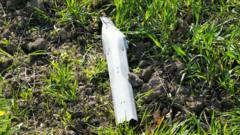
Estonia's military shot down a drone over its airspace on Wednesday, marking a rare escalation near NATO territory. Officials suspect the unmanned aircraft originated from Ukraine and was damaged or disoriented by Russian electronic jamming before crossing into Estonian territory.
The incident highlights the spillover risks from the Russia-Ukraine conflict, where combat operations routinely push equipment across borders. Russian jamming systems, designed to disable Ukrainian drones and missiles, sometimes scatter munitions unpredictably rather than destroying them entirely. Estonia, a NATO member bordering Russia and Ukraine, sits in a precarious zone where stray ordnance from the eastern conflict regularly drifts westward.
The Estonian government has not revealed the drone's type or payload, but military officials emphasized the importance of enforcing airspace sovereignty. NATO allies monitor such intrusions carefully, as any attack on a member state triggers Article 5 collective defense obligations. However, officials downplayed escalation risk, framing the incident as an accident rather than intentional aggression.
This reflects a pattern NATO faces along its eastern flank. Polish, Romanian, and Lithuanian airspace have all experienced drone incursions traced to Ukraine-Russia operations. Most incidents result in military interception without diplomatic fallout, provided the violations remain acknowledged as collateral damage rather than deliberate provocation.
Estonia's response demonstrates NATO's readiness to defend airspace while managing tensions carefully. The country's military maintains close coordination with allied forces, ensuring rapid response to any breach. Officials are investigating the drone's origin and trajectory to confirm whether electronic jamming by Russian forces contributed to the airspace violation. The incident underscores how NATO members must balance firm territorial defense with restraint in interpreting accidental military incursions.