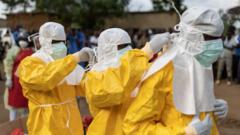
The Democratic Republic of Congo faces a serious public health crisis as authorities declared an Ebola outbreak a health emergency. Nearly 250 suspected cases have been reported in the affected region, triggering urgent containment efforts.
The declaration reflects growing concern among health officials about transmission rates and the outbreak's potential to spread beyond initial hotspots. DR Congo has experienced multiple Ebola outbreaks over the past decade, making the nation's health infrastructure and response protocols critical factors in controlling this surge.
Ebola's mortality rate typically ranges from 25 to 90 percent depending on the virus strain and access to treatment. Early detection, isolation of confirmed cases, and coordination between international health organizations and local authorities remain essential to limiting casualties. The outbreak's severity depends on several variables: how quickly healthcare workers identify new cases, whether communities follow infection-prevention guidance, and the availability of supportive care in remote regions where cases often emerge.
DR Congo's previous outbreaks demonstrated both the country's capacity to mobilize resources and the challenges posed by limited infrastructure in certain areas. Health workers face dangers while conducting contact tracing and administering care. Cross-border movement in Central Africa complicates containment efforts, as infected individuals may unknowingly travel to neighboring countries.
International health bodies including the World Health Organization monitor the situation closely. Vaccination campaigns and medical supplies have proven effective in past outbreaks, though access and vaccine hesitancy remain obstacles in some communities.
The next weeks prove critical. If case numbers stabilize and cluster around known transmission chains, the outbreak remains manageable. Rapid escalation signals a more dangerous trajectory requiring expanded international response.