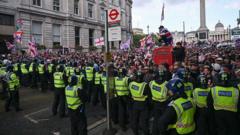
The Metropolitan Police deployed 4,000 officers and armoured vehicles to manage two competing demonstrations scheduled simultaneously in central London. The Unite the Kingdom rally and the annual Nakba march, marking the displacement of Palestinians in 1948, converged on the same date, forcing police to prepare for potential flashpoints between opposing crowds.
The Met's decision to stage armoured vehicles signals anticipation of heightened tensions. Both protests draw passionate supporters with fundamentally opposed political positions. Unite the Kingdom attracts right-wing demonstrators, while the Nakba march draws pro-Palestinian activists and their allies. Historical precedent shows London protests around Israeli-Palestinian issues generate intense counter-protest activity and require substantial police resources.
The 4,000-officer deployment represents a major commitment of Met resources. This figure typically triggers when authorities expect large crowds, possible confrontations, or disruptions to public order. Armoured vehicles, deployed selectively in UK policing, indicate the force's assessment that the risk profile demands defensive infrastructure.
London has hosted numerous competing demonstrations in recent years, particularly since October 2023 and the escalation in Gaza. Police have repeatedly managed large pro-Palestinian marches alongside counter-protests. The Met's operational playbook typically involves creating buffer zones between opposing groups, deploying mounted officers, and maintaining rapid-response units.
The timing creates logistical complexity. Both marches hold deep cultural and political significance for their participants. The Met must balance protest rights under UK law against public safety obligations. Restricting either march triggers legal challenges and accusations of bias. The force's preferred strategy involves robust stewarding, clear communication with march organisers, and visible presence rather than intervention unless disorder emerges.
Whether the dual protests remained peaceful or generated arrests depends on actual crowd behaviour. The Met's preparation reflects standard protocol for high-stakes simultaneous demonstrations in the capital, where competing political narratives regularly intersect on the streets.