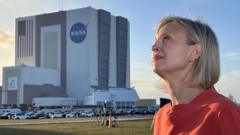
Rebecca Morelle, BBC Science Editor, documented her experience following NASA's historic lunar mission from launch through splashdown. Morelle observed the mission's major milestones, capturing the emotional weight of watching a crew return safely from the Moon.
The piece reflects on the human drama inherent in space exploration. Morelle witnessed the tension of liftoff, the technical precision required for lunar operations, and the relief of a successful water landing. Her account privileges the visceral experience of covering a rare moment in space history, when NASA executed a complex mission involving crew safety, international stakes, and decades of engineering expertise.
This mission represents a return to human lunar exploration after a long hiatus. NASA's Artemis program aims to establish sustained human presence on the Moon, marking a shift from decades-long focus on low-Earth orbit and robotic exploration. The successful mission validates the agency's approach and demonstrates technical readiness for deeper space operations.
For science journalism, Morelle's firsthand coverage underscores how space exploration still commands public attention and emotional investment. Even in an era of routine spaceflight from commercial operators, government lunar missions generate unique urgency. The mission's success also provides momentum for NASA's broader agenda, including eventual Mars exploration, and validates continued funding and public support for ambitious space programs.
Morelle's reflection serves as both personal testimony and historical record of a pivotal moment in human spaceflight. Her account reminds readers that behind mission data and engineering achievements sits the raw experience of witnessing humanity's expansion into space.
WHY IT MATTERS: NASA's successful lunar mission signals renewed momentum for human deep-space exploration and validates the Artemis program's path toward sustained Moon operations and eventual Mars missions.