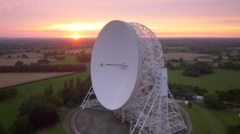
The UK government's proposed cuts to science funding threaten to decommission Jodrell Bank, one of the world's most historically significant radio telescopes. Located in Cheshire, the 70-year-old facility has made groundbreaking discoveries since its construction and remains a cornerstone of British astronomy research.
The closure would devastate UK radio astronomy. Jodrell Bank operates as part of the Multi-Element Radio Linked Interferometer Network (MERLIN), a distributed network of telescopes across Britain. Shutting it down would cripple the network's observational capacity and eliminate Britain's ability to conduct cutting-edge radio astronomy research at the sensitivity levels the facility currently provides.
Astronomers argue the cuts would leave a generation without proper training infrastructure. Young researchers depend on facilities like Jodrell Bank to develop expertise in radio astronomy and data analysis. Loss of the telescope removes hands-on experience opportunities at a critical moment when the field needs skilled practitioners for next-generation projects like the Square Kilometre Array, a €1.9 billion international initiative launching in the coming decade.
The science community has pushed back hard. The closure would reduce Britain's competitive position in global astronomy partnerships and abandon decades of institutional knowledge embedded at the facility. Jodrell Bank attracts international collaborators and contributes to time-sensitive research including pulsar monitoring and transient detection that cannot simply shift to other facilities.
Budget pressures from the UK government's broader spending constraints have forced difficult decisions across research institutions. However, losing Jodrell Bank represents a step backward for a nation that historically led radio astronomy innovation. The facility's iconic status, combined with its active scientific output, makes it a symbol of what British science stands to lose under these proposed cuts.
The decision remains under review, but the astronomy community's warning is clear. Decommissioning Jodrell Bank would hollow out UK research capacity at precisely the moment when international competition for astronomical discovery is intensifying.