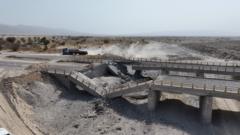
US military forces launched strikes against Iran for the seventh consecutive night, targeting what Pentagon officials describe as Iranian armed forces infrastructure. The campaign represents an escalation in direct military action between Washington and Tehran, following months of rising regional tensions.
Iran confirmed explosions near the Strait of Hormuz, one of the world's most critical shipping chokepoints through which roughly one-third of global maritime petroleum traffic passes. The Iranian military has not yet detailed casualties or damage from the sustained bombardment.
US Central Command framed the operation as a degradation campaign aimed at reducing Iran's military capabilities. The multi-night strike sequence suggests coordinated, planned action rather than reactive measures. Neither Washington nor Tehran has provided detailed breakdowns of specific targets hit during the seven-day assault.
The escalation carries immediate implications for global energy markets and shipping security. The Strait of Hormuz remains a flashpoint for US-Iranian brinkmanship, and military action in proximity to the waterway raises risks of accidental escalation or direct interference with commercial shipping routes.
The strikes follow a pattern of tit-for-tat exchanges between the two powers across the Middle East. Regional allies, including Israel and Gulf Cooperation Council states, have watched the developments closely. Russia and China have signaled concern about the military escalation.
The sustained nature of the campaign, now spanning a full week, suggests either a planned series of operations or a conflict cycle that neither side has moved to de-escalate. Intelligence officials have not ruled out additional strikes, leaving the duration and intensity of the operation unclear. The implications for broader Middle East stability remain under active assessment by regional and Western powers monitoring the situation.