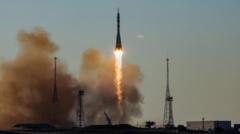
A Soyuz spacecraft lifted off from the Baikonur Cosmodrome in Kazakhstan, carrying NASA astronaut Anil Menon and Russian cosmonauts Pyotr Dubrov and Anna Kikina toward the International Space Station. The trio will spend eight months aboard the orbiting laboratory conducting experiments and maintaining station systems.
Menon, a former Air Force pilot and physician, marks another chapter in the ongoing international collaboration between NASA and Russia's space agency, despite geopolitical tensions. Dubrov and Kikina bring extensive spaceflight experience to the mission. Kikina, notably, becomes one of Russia's active female cosmonauts contributing to the ISS rotation.
The Soyuz remains the primary vehicle ferrying crew to and from the station. SpaceX's Crew Dragon has emerged as a second option for NASA missions since 2020, but Soyuz launches continue regular schedule despite recent friction between the US and Russia. This crew rotation demonstrates the ISS program's resilience as a rare pocket of sustained scientific cooperation.
The mission arrives as the station hosts ongoing microgravity research across biology, materials science, and Earth observation. The incoming crew will join existing expedition members already conducting investigations. Eight-month rotations provide continuity for long-term experiments requiring sustained human oversight.
Soyuz launches from Kazakhstan represent decades of proven reliability. The spacecraft design, rooted in Cold War-era Soviet engineering, has remained largely unchanged because it works. This particular mission underscores how spaceflight infrastructure transcends political divisions when scientific goals align. The successful launch keeps the ISS fully crewed and operational through another research cycle.