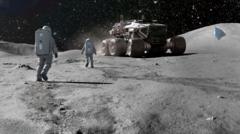
Helium-3, a rare isotope of helium, has become the subject of serious lunar mining proposals as demand accelerates and Earth-based supplies dwindle. The isotope costs roughly $100,000 per gram on the open market, making it one of the planet's most expensive substances.
Unlike its common counterpart helium-4, helium-3 possesses unique properties that make it valuable for medical imaging, semiconductor manufacturing, and theoretical fusion energy research. Current global demand centers on the medical sector, where helium-3 fuels MRI machines and detection equipment. Forecasts predict demand will rise sharply as industries explore new applications.
Earth's helium-3 reserves sit at critically low levels. The U.S. Strategic Helium Reserve, once substantial, has steadily depleted since the 1990s. Supplies come primarily as byproducts of nuclear weapons decommissioning, a finite resource that cannot sustain projected demand growth.
The moon offers an alternative. Solar winds have deposited helium-3 particles across the lunar surface for billions of years. Scientists estimate the moon contains approximately one million tons of the isotope, far exceeding Earth's reserves. Mining it would require extracting regolith (lunar soil), heating it to release trapped helium-3, then transporting it back to Earth.
Several space agencies and private companies have begun serious planning around lunar helium-3 extraction. The technological and financial barriers remain steep. Establishing mining infrastructure on the moon requires sustained investment and advanced robotics. Transport costs currently make lunar helium-3 economically unviable compared to terrestrial sources, though launch costs continue falling.
If fusion energy breakthroughs accelerate, demand could shift dramatically. Helium-3 proves ideal for advanced fusion reactors, potentially unlocking clean energy at scale. That scenario would justify the astronomical costs of lunar operations and transform space resource extraction from science fiction into industrial reality.