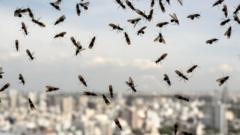
Flying Ant Day sounds like folklore. It isn't. Each summer, across the UK and Europe, carpenter ants and other species undergo synchronized mating flights, creating swarms so dense they register on weather radar. The BBC's Sophia Herod clarifies the popular misconception that this phenomenon occurs on a single date.
The event doesn't align to any calendar day. Instead, it unfolds gradually through summer months, triggered by specific weather conditions rather than a fixed temporal marker. When temperatures rise, humidity peaks, and wind patterns align, reproductive ants emerge from their colonies en masse. The timing varies by region and species, making "Flying Ant Day" a misnomer that persists in British culture despite its inaccuracy.
Different ant species launch their nuptial flights at different times. Lasius niger, the garden black ant, typically flies first, often in July. Other species follow through August and beyond. The phenomenon persists longer than a single day because colonies don't all synchronize perfectly, and new cohorts emerge as conditions remain favorable.
Weather plays the decisive role. Rain triggers the flights by loosening soil and creating ideal moisture levels. Warm afternoons with low wind speeds typically see the heaviest activity. This explains why certain years or regions experience more dramatic swarms than others, and why predictions remain notoriously unreliable despite media hype surrounding the concept.
The swarms serve evolutionary purpose. Males and females from different colonies mate mid-flight, dispersing genetic material across populations and establishing new colonies. After mating, females discard their wings and seek nesting sites, while males die shortly after reproduction concludes.
The collective cultural shorthand of "Flying Ant Day" persists because the visual spectacle captures public imagination. Yet ecologically and behaviorally, the phenomenon deserves more precise terminology. It's a seasonal event rather than an annual rite, a gradual emergence rather than a coordinated strike.