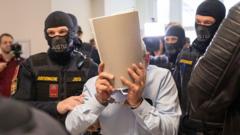
An Austrian court convicted a former Syrian intelligence chief of torture and sexual abuse crimes committed against political opponents under Bashar al-Assad's regime. The trial took place in Vienna, marking one of the few legal accountability proceedings for Syrian government officials outside their home country.
The conviction represents a rare moment of justice for victims of Assad's security apparatus. Syria's notorious intelligence agencies, including the feared State Security Bureau, systematized torture as a tool of political control. Detainees faced electric shocks, beatings, and sexual violence in underground prisons for years without trial.
Austria pursued the case under universal jurisdiction, a legal principle allowing courts to prosecute serious crimes like torture regardless of where they occurred or the nationality of perpetrators. The Vienna prosecution built its case on testimony from survivors and witnesses who fled Syria and found refuge in Europe.
This trial joins similar proceedings in Germany, where courts have convicted Syrian officials including a former colonel of Bashar al-Assad's Air Force Intelligence Directorate. These European legal actions fill a vacuum created by the absence of international justice mechanisms. The International Criminal Court lacks jurisdiction in Syria since the country never joined the Rome Statute, and the UN Security Council has blocked ICC referrals due to Russian and Chinese vetoes.
Hundreds of thousands died in Syria's decade-long civil war. Assad's torture apparatus created an estimated 130,000 enforced disappearances. Millions fled as refugees, many settling in Europe where they encountered their former torturers and reported them to authorities.
The conviction sends a message that perpetrators cannot escape accountability by fleeing their countries. For Syrian survivors scattered across the diaspora, Austrian justice offers a measure of recognition for decades of trauma. Yet it remains a drop in an ocean of unresolved crimes. Most Syrian officials responsible for systematic torture remain at large, protected by Assad's government or living anonymously abroad.