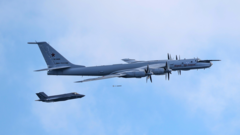
UK fighter jets from RAF Lossiemouth scrambled to intercept a Russian military aircraft over the Norwegian Sea on Wednesday. The Royal Air Force Typhoon jets encountered the unidentified Russian plane in international airspace, prompting the Ministry of Defence to characterize the incident as evidence of ongoing provocative behavior by Moscow.
A Defence Ministry spokesman described Russia's activity as "unsafe and unprofessional," echoing familiar language from previous interceptions. The incident reflects escalating tensions between NATO allies and Russia in northern European waters, a region that has seen repeated encounters since Russia's 2022 invasion of Ukraine.
Russian military aircraft routinely probe NATO airspace boundaries in the region. These operations test allied response times and air defense capabilities while maintaining plausible deniability through use of international waters and airspace. British jets regularly intercept these incursions, typically Russian long-range patrol or reconnaissance aircraft venturing toward UK or allied territory.
The Norwegian Sea remains a geopolitical flashpoint. Russia operates from bases in the Arctic and Kola Peninsula, positioning strategic bombers and maritime patrol aircraft for surveillance missions targeting NATO's northern flank. The UK maintains constant Quick Reaction Alert patrols from Scottish bases to counter such intrusions.
Wednesday's encounter follows months of similar incidents reported by RAF, Norwegian, and other allied air forces. Each intercept demonstrates NATO's commitment to defending its airspace while signaling to Moscow that such operations carry operational risk and political cost. The characterization of Russian behavior as "unsafe" references the military term for operations lacking adequate safety procedures or coordination with other aircraft.
These interceptions serve dual purposes. Operationally, they prevent Russian intelligence-gathering close to NATO territory. Politically, they provide public reassurance that allied air defenses function effectively. For the UK, such incidents reinforce its role as a European security anchor, particularly important post-Brexit as Britain emphasizes NATO commitment and European defense partnerships.