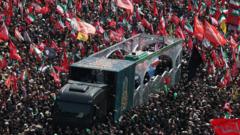
Iran's Supreme Leader Ayatollah Ali Khamenei drew massive crowds to his funeral procession in Tehran, with mourners waving national flags and red banners that symbolized calls for vengeance following his death in military conflict. The scale of public turnout underscored Khamenei's hold over the Iranian state and his role as the country's highest authority since 1989.
Khamenei's death marks a seismic shift in Iranian politics. As Supreme Leader, he controlled the military, judiciary, and state media, making him far more powerful than the elected president. His 35-year tenure shaped Iran's foreign policy, regional military operations, and domestic governance through an iron grip on institutions. The red banners reflected hardline sentiment within Iran's leadership and populace, signaling potential escalation in regional tensions.
The funeral procession revealed deep fractures within Iranian society. While state-organized crowds gathered in central Tehran, Khamenei's death creates an immediate succession crisis. The Assembly of Experts, a clerical body, must select the next Supreme Leader. Potential candidates include military officials, conservative clerics, and technocrats aligned with the Islamic Revolutionary Guard Corps.
Iran's regional posture now faces uncertainty. Khamenei directed proxy forces across Syria, Iraq, Lebanon, and Yemen. His backing of Hezbollah and other militant groups defined Middle Eastern geopolitics. Without his authority, these networks may fracture or require recalibration under new leadership.
International observers, particularly in Israel and the Gulf states, monitor developments closely. The succession process will determine whether Iran maintains its aggressive regional strategy or pivots toward pragmatism. Revolutionary Guard commanders may push for continuity, while younger reformists could advocate moderation, though such voices hold limited power within Iran's clerical system.
The next Supreme Leader will inherit Khamenei's war legacy and the economic sanctions crushing Iran's currency. How the new leadership navigates these pressures will reshape Middle Eastern security calculations for years ahead.