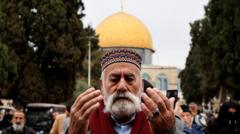
Israeli nationalist groups are challenging long-standing restrictions at the al-Aqsa Mosque compound in Jerusalem, one of Islam's holiest sites. The compound, also sacred to Jews as the Temple Mount, operates under a status quo agreement that limits Jewish prayer and religious practice in shared spaces.
The convention, established decades ago, allows Jews to visit but historically prohibited formal prayer at the site. Israeli nationalists now openly defy these unwritten rules, with groups conducting prayers and religious ceremonies in restricted areas. This escalation disrupts the delicate balance that has governed the compound since the 1967 Six-Day War.
The al-Aqsa Mosque serves as a primary symbol of Palestinian identity and Islamic heritage. Increased Jewish prayer there triggers Palestinian and broader Muslim opposition, creating friction that extends beyond Jerusalem into regional tensions. Previous incursions have sparked violence and confrontations between Israeli security forces and Palestinian worshippers.
Israeli authorities face pressure from nationalist constituencies demanding expanded religious access while managing the practical reality that such actions inflame Arab-Israeli tensions. Palestinian leadership views these violations as provocations threatening their claims to the site and Jerusalem more broadly.
The status quo, though imperfect, has prevented worse escalation for decades. The emerging pattern of nationalist rule-breaking suggests that informal agreements may no longer hold. Without enforcement or renegotiation, the compound risks becoming a flashpoint for renewed conflict.
Both communities view the site as foundational to their identity and claims on Jerusalem. These competing narratives make compromise difficult. The breakdown of restraint among Israeli nationalists signals a potential shift in how contested religious spaces function in the city.