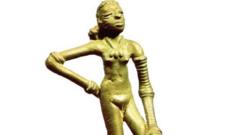
India's National Council of Educational Research and Training (NCERT) reversed course on censoring one of the subcontinent's most iconic archaeological treasures. The "Dancing Girl" figurine from the Indus Valley Civilization now appears in school textbooks with her original bare torso restored after public outcry.
The 4,400-year-old bronze statue from Mohenjo-daro had been digitally altered in a new textbook edition, with dark shading obscuring her chest. The modification sparked immediate backlash from archaeologists, historians, and cultural commentators who viewed the censorship as historically inaccurate and disrespectful to India's pre-Aryan heritage.
The Dancing Girl ranks among archaeology's most celebrated finds. Discovered in 1926, the figure represents a pinnacle of Indus Valley artistic achievement and offers rare insight into Bronze Age civilization in South Asia. Her confident pose and minimalist ornamentation have inspired countless interpretations about gender, art, and social status in ancient societies.
By altering the artifact for contemporary sensibilities, NCERT faced accusations of imposing modern moral frameworks onto ancient history. Critics argued that educational materials must present archaeological evidence faithfully, particularly when teaching students about their own cultural past. The decision also raised questions about whose values shape how history gets told in classrooms.
NCERT's reversal acknowledges that educational integrity demands presenting historical objects authentically. The figurine's bare torso carries no sexual connotation in its original context. Rather, it documents how humans dressed, moved, and expressed themselves thousands of years ago.
This episode reflects broader tensions in India around cultural nationalism, religious conservatism, and academic freedom. Textbook content increasingly faces scrutiny from various groups seeking to reshape curricula. The Dancing Girl's restoration suggests, at least momentarily, that historical accuracy retained ground against revisionism.