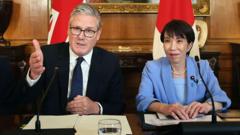
Japan and the UK have sealed an £18 billion investment agreement focusing on infrastructure and offshore wind energy, Downing Street announced. Japanese companies will direct capital into British wind farms and broader infrastructure projects as part of the bilateral economic partnership.
The deal represents a significant step in post-Brexit trade relations, cementing Japan's position as a major investor in UK energy transition. Offshore wind has become central to Britain's net-zero strategy, with the sector requiring substantial foreign capital to meet ambitious generation targets.
The announcement comes as the UK government prioritizes attracting foreign direct investment to shore up economic growth. Japanese investment has historically been resilient in Britain, with Japanese manufacturers maintaining strong operations in automotive and electronics sectors. This latest commitment broadens that footprint into renewable energy infrastructure.
The specifics of project allocation remain limited in the initial announcement, but the scale signals Tokyo's confidence in UK market stability despite recent economic headwinds. Japan faces its own energy challenges following nuclear capacity constraints and aims to diversify renewable investments across allied nations.
The timing aligns with broader Western efforts to reduce energy dependence on adversarial regimes and deepen economic ties among democratic nations. Britain's offshore wind pipeline includes major projects in the North Sea and around coastal waters, all requiring billions in construction and equipment spending.
This agreement likely includes commitments across multiple Japanese conglomerates with existing UK operations. Companies in infrastructure development, renewable energy technology, and industrial manufacturing typically lead such bilateral investment frameworks.
The deal underscores how post-Brexit Britain is positioning itself as an investment destination outside European Union structures, leveraging historical financial relationships and shared security partnerships to attract capital from major economies.