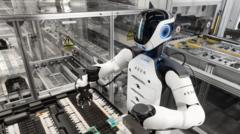
BMW is deploying humanoid robots at one of its European manufacturing facilities, following pilot programs the automaker has already launched stateside. The move positions the German luxury carmaker as an early adopter of bipedal automation in automotive production, where traditional industrial robots have long dominated assembly lines.
The humanoid units bring distinct advantages to car manufacturing. Unlike fixed robotic arms bolted to factory floors, these machines navigate human-designed workspaces without retrofitting. They access tight spots, handle delicate components, and adapt to multiple tasks on the same line. BMW sees them handling welding, assembly, and quality control operations that currently demand human dexterity or workspace flexibility.
This deployment reflects broader automation trends reshaping automotive production. Tesla, Hyundai, and other manufacturers have invested in humanoid robotics research, betting that next-generation factories will blend human and robotic labor. BMW's European rollout signals confidence that the technology has matured beyond novelty into operational utility.
Labor implications remain contested. BMW hasn't announced workforce reductions tied to the humanoid deployment, though the technology's long-term trajectory suggests eventual job displacement in repetitive manufacturing roles. European unions, particularly in Germany, have historically negotiated transition arrangements when automation accelerates. The company's phased approach across multiple plants may allow managed workforce adjustments.
Supply chain resilience also drives adoption. As semiconductor shortages and geopolitical tensions disrupt just-in-time manufacturing, humanoid robots offer flexibility. They retool faster than traditional automation when production demands shift between models or markets.
The technology remains expensive. Units from companies like Boston Dynamics and Tesla's Optimus cost hundreds of thousands of dollars, making economic justification dependent on scale and utilization rates. BMW's European deployment tests whether humanoid robots can achieve the productivity thresholds that justify their capital investment against traditional industrial automation.
This marks a inflection point for automotive manufacturing. If BMW's European plant demonstrates strong returns, expect rapid adoption across the sector.