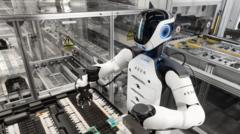
BMW has deployed humanoid robots at a European car manufacturing facility as the automaker doubles down on automation across its production network. The German carmaker follows comparable automation initiatives already underway at US plants, signaling a broader industry shift toward robotic labor on factory floors.
Humanoid robots offer manufacturers flexibility in assembly-line environments designed for human workers. Unlike traditional fixed-automation systems, these robots can navigate spaces, manipulate components, and adapt to different tasks with minimal retooling. For BMW, the deployment addresses persistent labor challenges and production bottlenecks while maintaining the precision automotive assembly demands.
The move reflects competitive pressure across premium automaking. Tesla, Hyundai, and other OEMs have invested heavily in robotics and AI-driven manufacturing. BMW's pivot positions the company to lower per-unit costs and accelerate production cycles as EV demand reshapes supply chains.
Industry analysts note humanoid robots remain expensive and technically imperfect. Integration timelines stretch longer than traditional automation, and upfront capital requirements are steep. Yet manufacturers view the technology as essential infrastructure for next-generation factories. Workforce implications loom large. German labor unions have expressed concern about job displacement, though BMW has not announced layoffs tied to the robot deployment.
The automaker frames humanoid robots as "the future" of car making, betting that productivity gains and labor cost reductions justify the investment. Successful deployment at European and US plants could establish a template for competitors. If BMW achieves expected efficiency targets, expect rapid adoption across Tier One suppliers and other luxury OEMs.
This moment marks a tipping point. Humanoid robotics transition from research labs to production floors. Automotive manufacturing, already highly automated, becomes the proving ground for systems that could reshape factories across industries.