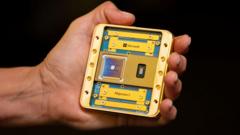
Microsoft unveiled a quantum chip called Willow that delivers a tenfold improvement in error rates compared to its previous generation hardware. The company claims the breakthrough advances its timeline for building a quantum computer capable of solving real-world commercial problems by 2030.
Quantum computers exploit the physics of subatomic particles to process information in fundamentally different ways than classical machines. They excel at specific tasks like drug discovery, materials science, and optimization problems. The central challenge has always been error rates. Quantum bits, or qubits, are fragile and prone to errors that compound as calculations grow more complex.
Willow reportedly reduces errors by 99.7 percent compared to Microsoft's predecessor chip. The company demonstrated the advancement by running benchmark tests that would take classical supercomputers thousands of years to complete. Microsoft framed this as evidence that error correction, the holy grail of quantum computing, is becoming viable at scale.
The announcement positions Microsoft in direct competition with IBM, Google, and Amazon in the quantum race. Google claimed "quantum supremacy" in 2019 when its Sycamore processor completed a calculation faster than classical computers, though the practical applications remained limited. Microsoft's focus on error reduction targets the real bottleneck holding back commercial quantum adoption.
The company predicts quantum computers will reshape industries within five years but acknowledges engineering hurdles remain. Building stable, scalable systems requires solving problems in cryogenics, control systems, and software architecture that extend beyond chip design alone.
Microsoft's timeline depends on continued hardware advances and breakthroughs in quantum algorithms. Success would unlock applications in pharmaceuticals, finance, and manufacturing that could justify massive R&D investments across the industry.