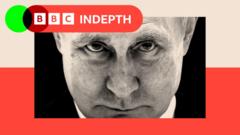
Vladimir Putin has spent three decades constructing and reconstructing his public persona with calculated precision. The BBC examines how the Russian leader transformed from a shadowy KGB operative into a carefully curated wartime figurehead.
In the 1990s, Putin emerged from Soviet intelligence services into Yeltsin's chaotic Russia, initially presenting himself as a pragmatic technocrat. He leveraged his background in espionage to project competence and order during a period of national instability. This image resonated with a Russian public exhausted by economic collapse and political uncertainty.
Once in power, Putin shifted tactics. He cultivated an archetype of masculine strength, orchestrating photoshoots featuring bare-chested exploits, martial arts displays, and outdoor adventures. These carefully staged moments reinforced his positioning as a decisive, physically commanding leader capable of restoring Russian pride. The strategy proved effective across domestic and international audiences.
As external challenges mounted, particularly following NATO expansion and the Georgia conflict, Putin rebranded again. He positioned himself as defender of Russian civilization against Western encroachment, invoking Orthodox Christianity and traditional values. This narrative gained traction among conservative constituencies and Russian diaspora communities.
The 2022 invasion of Ukraine marked another reinvention. Putin shifted from strongman to wartime leader, employing rhetoric of existential struggle and historical destiny. State media amplified this persona while tightly controlling information about military setbacks. His image operations faced unprecedented obstacles, however, as independent reporting and social media undermined traditional propaganda channels.
Throughout these transformations, Putin's image management relied on controlling visual narratives, limiting critical media access, and leveraging state resources to amplify preferred messaging. Each reinvention addressed specific domestic and international pressures while maintaining core themes of strength and Russian restoration. His success in repeatedly reshaping his public persona reveals how authoritarian leaders exploit image control as a tool of statecraft.