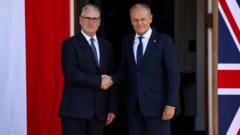
UK Prime Minister Keir Starmer and Polish counterpart Donald Tusk signed a new bilateral treaty at RAF Northolt, cementing security cooperation between the two NATO allies. Starmer used the occasion to issue a stark warning about Russian aggression, framing the agreement as a necessary response to heightened threats in Eastern Europe.
The treaty solidifies defense commitments between Britain and Poland at a moment when Russian military activity near European borders remains elevated. Poland, positioned directly on NATO's eastern flank, faces particular vulnerability. The formal agreement grants both nations clearer frameworks for military coordination, intelligence sharing, and rapid-response protocols.
Starmer's rhetoric directly targeted Moscow's behavior, characterizing Russian actions as a destabilizing force that demands unified NATO resolve. The UK prime minister has consistently positioned Britain as a guarantor of European security post-Brexit, working to rebuild diplomatic leverage on the continent after years of fractious relations under his predecessor.
The timing carries diplomatic weight. As Russia continues operations in Ukraine and Western intelligence reports persistent hybrid threats across NATO member states, Britain signals it remains committed to collective defense. Poland's government under Tusk, himself a former European Council president, prioritizes robust Western engagement and military modernization.
For the UK, the treaty reinforces Starmer's post-election pivot toward strengthening relationships with European counterparts. For Poland, the agreement provides additional security assurances alongside existing NATO guarantees, particularly important given the country's role as a crucial supply corridor for Ukraine aid.
The formalized accord demonstrates that bilateral security arrangements remain vital alongside collective NATO structures. Both leaders used the occasion to underscore that European security cannot be taken for granted and that investment in defense infrastructure and military readiness remains essential.