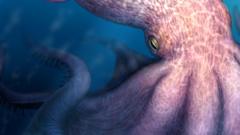
Paleontologists have uncovered fossil evidence suggesting that giant octopuses roamed Earth's oceans roughly 100 million years ago, potentially reaching lengths of 19 metres. The discovery reshapes understanding of prehistoric marine ecosystems and the evolutionary timeline of cephalopods.
The fossil record previously offered sparse evidence of ancient octopus species, leaving gaps in scientists' knowledge about when and how these creatures evolved their distinctive intelligence and hunting abilities. This new finding plugs that gap with tangible proof that colossal cephalopods existed during the Cretaceous period, competing for dominance alongside plesiosaurs and other marine reptiles.
A 19-metre octopus would have commanded significant predatory power in ancient seas, capable of hunting large fish and potentially smaller marine reptiles. For comparison, modern giant octopuses typically max out around 9 metres and weigh up to 272 kilograms. The Cretaceous specimens would have been roughly twice that size, placing them among the ocean's apex predators.
The fossils reveal anatomical features consistent with modern octopuses, including arm structure and sucker arrangements, suggesting these ancient creatures employed similar hunting and feeding strategies to their modern descendants. This continuity demonstrates remarkable evolutionary stability within the cephalopod lineage over 100 million years.
The discovery carries implications for understanding food-web dynamics in Cretaceous oceans. Predators of this scale would have required abundant prey and occupied distinct ecological niches. Their presence alongside marine reptiles and early sharks indicates a diverse, hierarchical marine environment far more complex than previously documented.
Researchers continue analyzing the fossils to extract additional details about behaviour, growth patterns, and lifespan. Future studies may reveal whether these giants faced competition from other predators or if they dominated their ecological niche unchallenged until mass extinction events reshaped ocean life 66 million years ago.