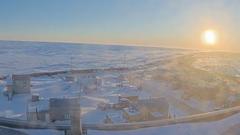
Utqiagvik, Alaska, just witnessed its final sunset for the next 84 days. The northernmost city in the United States enters a period of continuous daylight known as the midnight sun, a natural phenomenon driven by Earth's axial tilt and the Arctic location.
The town's roughly 4,300 residents will experience uninterrupted sunlight until late August, when the sun finally dips below the horizon again. This extreme seasonal pattern is a defining characteristic of life above the Arctic Circle, where the sun's position in the sky shifts dramatically between summer and winter months.
During winter, Utqiagvik flips the script entirely. The town endures approximately 65 days of complete darkness, known as polar night, when the sun never rises above the horizon. These twin extremes shape every aspect of daily life for residents, from sleep patterns and mental health to work schedules and outdoor activities.
The phenomenon occurs because of Earth's 23.5-degree axial tilt relative to its orbital plane around the sun. During summer months in the Northern Hemisphere, the Arctic region tilts directly toward the sun, pushing it above the horizon continuously. Conversely, during winter, the same region tilts away, plunging the area into darkness.
Utqiagvik attracts researchers studying the midnight sun's effects on human physiology and psychology. Scientists examine how extended daylight influences circadian rhythms, sleep quality, and seasonal mood disorders. Local residents develop personal coping strategies, from blackout curtains to disciplined bedtime routines.
The continuous daylight also offers practical advantages. Residents can engage in outdoor activities throughout the clock without artificial lighting. Fishing, hunting, and other traditional pursuits benefit from the extended daylight hours. Tourism spikes during summer months as visitors travel north to experience this unique celestial event.