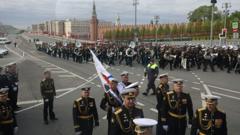
The Kremlin scaled back its May 9 Victory Day parade in Moscow this year, removing the military hardware that traditionally dominates Red Square and broadcasts state power to global audiences. BBC Russia Editor Steve Rosenberg observed a notably diminished display, suggesting a shift in how Vladimir Putin's government projects strength amid ongoing economic strain from sanctions and the war in Ukraine.
Victory Day parades typically feature tanks, missiles, and artillery formations parading through Red Square, a carefully choreographed display of military capability aimed at domestic audiences and foreign observers. The absence of weaponry signals either logistical constraints or a calculated decision to alter the parade's messaging. Russia's military has suffered substantial equipment losses in Ukraine. Sending hardware to Red Square would draw it away from active combat zones, a trade-off the Kremlin may have deemed unsustainable.
The symbolic weight matters. These parades commemorate Soviet victory in World War II but function as modern statements about Russian military readiness. A stripped-down version potentially undermines that projection. Rosenberg's reporting suggests the parade retained ceremonial elements but lacked the mechanical thunder viewers have seen for decades.
This moment reflects broader pressure on Russia's economy and defense capabilities. Sanctions have constrained access to advanced components. The Ukraine conflict consumes equipment faster than production can replace it. A parade without tanks or missiles tells a different story to Russians and the world.
The decision reveals cracks in the Kremlin's ability to maintain traditional spectacle while sustaining a grinding military campaign. It's a quiet but visible acknowledgment that resources are finite.