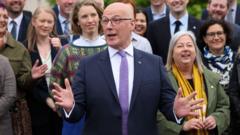
John Swinney, leader of the Scottish National Party, has shut the door on any coalition or confidence-and-supply arrangement with Reform UK following Scotland's parliamentary election. The SNP retained power with 58 seats in Holyrood, marking their fifth consecutive election victory, but the tally falls short of the 65 seats needed for outright control.
Swinney's refusal to engage with Reform UK signals the SNP's preference to pursue alternative paths to governance, likely pivoting toward existing agreements with other parties or exploring fresh negotiations with Scottish Greens, who hold four seats. The nationalist bloc controlled Holyrood for two decades, and losing overall majority status creates genuine pressure on Swinney to stabilize his government quickly.
Reform UK's emergence as a Westminster-focused alternative-right party has unsettled traditional Scottish politics. Swinney's swift rejection of talks with the group reflects both ideological distance and tactical calculation. The SNP, positioned as center-left and independence-focused, has little common ground with Reform's populist, unionist platform.
The snub also underscores SNP confidence in its position. Holyrood's arithmetic favors the nationalists. A renewed SNP-Green pact, which governed Scotland from 2021 to 2023, remains the path of least resistance. Scottish Labour, the second-largest party with 22 seats, controls the opposition benches.
Swinney faces pressure to articulate his independence roadmap while managing minority government logistics. The 58-seat result, though dominant by regional standards, forces coalition mathematics that could complicate legislative agendas. His quick rejection of Reform UK buys political capital with his base while positioning the SNP as gatekeepers of progressive Scottish governance.
THE TAKEAWAY: The SNP opts for ideological alignment over numerical necessity, betting that partnership with Greens or confidence-and-supply arrangements offer better stability than negotiating with the populist right.