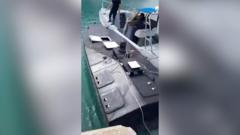
Greek authorities detonated explosives found aboard a mysterious unmanned naval drone discovered in a coastal cave. Fishermen stumbled upon the vessel Thursday, prompting the military to secure and assess the device.
The drone's origin remains unconfirmed, though initial reports suggest Ukrainian involvement. Greece's defense ministry treated the discovery as a potential security threat, initiating a controlled detonation to neutralize any ordnance aboard the unmanned craft.
The incident highlights the expanding scope of naval warfare technology in the ongoing Russia-Ukraine conflict. Unmanned vessels have emerged as critical tools for both Kyiv's military operations and intelligence gathering in the Black Sea and beyond. Ukrainian forces have deployed drone boats with increasing sophistication, targeting Russian assets and disrupting supply lines.
The discovery in Greek territorial waters raises questions about how far such devices travel and whether this particular craft operated independently or was decommissioned mid-mission. Drone vessels represent a relatively low-cost, high-impact asymmetric weapon that allows Ukraine to strike targets while minimizing personnel risk.
Greece maintains a delicate diplomatic balancing act between NATO membership and avoiding direct escalation in the Ukraine conflict. The controlled blast represents standard protocol for handling unexploded ordnance, though the vessel's suspected Ukrainian origin could trigger broader regional security discussions.
Naval drone technology continues evolving rapidly. Both Ukrainian and Russian forces have experimented with increasingly autonomous systems, from surface-level attack vessels to underwater variants. The appearance of such equipment in Greek waters underscores how the conflict's technological arms race extends beyond traditional battlefields and impacts neutral nations in neighboring regions.