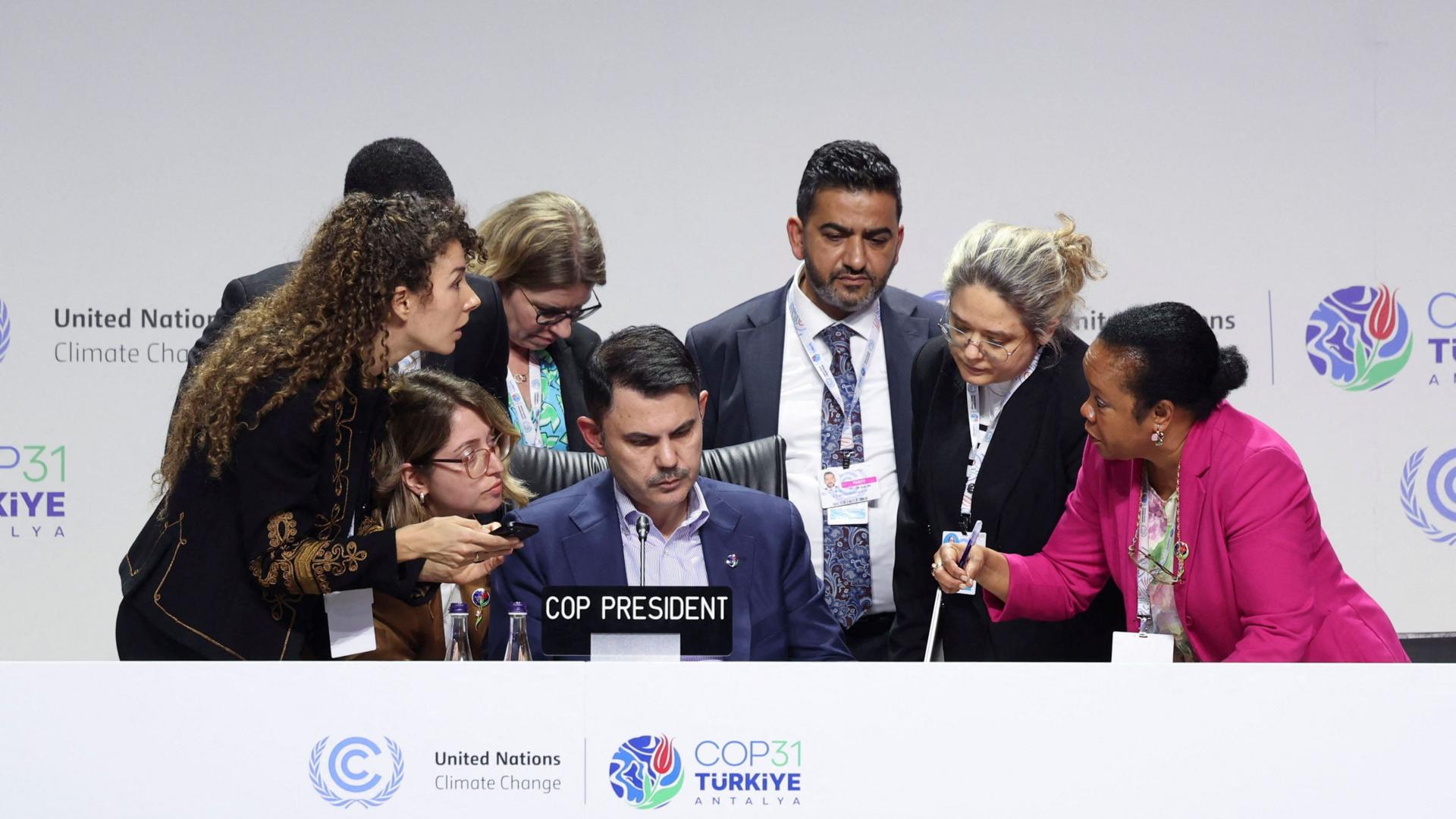
A new draft deal was published early Sunday at the UN COP31 climate summit in Antalya as negotiators attempted to prevent talks from collapsing on their second day of overtime.
The third version of the text omits the phrase "transitioning away from fossil fuels" but references a commitment countries made three years ago to do so. The move prompted divided reactions. The EU, which the BBC understands considers the new text a backward step, has not yet formally responded. Ministers from Panama, Solomon Islands, Côte d'Ivoire and others said removing fossil fuel language was unacceptable. Tuvalu's Climate Minister Maina Talia called it a "red line," saying "we're talking about the root cause of all of this." Australia's Climate Change and Energy Minister Chris Bowen argued the summit should focus on implementation and the shift toward clean energy rather than fossil fuel language.
The draft marks the first time a COP agreement acknowledges that the world is on track to miss the Paris climate accord goal of limiting warming to 1.5 degrees Celsius. It reduces references to carbon capture technology, potentially addressing EU concerns.
A key unresolved issue remains funding for developing nations. Earlier drafts included an agreement to increase adaptation money to $120 billion by 2035, but that figure has been removed. Ghana's Environment Minister Zanetor Agyeman Rawlings, speaking for the African Group, said negotiators "did not come here to beg, we came here to claim what is rightfully ours."
COP31 President Murat Kurum told the BBC he was "hopeful" of a breakthrough. A scheduled Sunday morning meeting to vote on the draft was delayed. These talks are now the longest-running in COP history. If countries cannot reach consensus, negotiations could suspend until next year, something that has occurred only once since COP talks began in 1995.