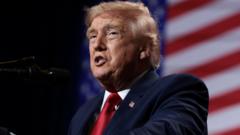
Donald Trump's remarks about a unified Ireland have become an unexpected flashpoint in international diplomacy, drawing scrutiny from political analysts on both sides of the Atlantic. The former president's comments appear calculated to resonate with Irish-American voters while simultaneously testing political dynamics in the United Kingdom and the Republic of Ireland.
Trump's statements on Irish reunification carry weight beyond their immediate context. The former president has long cultivated relationships with Irish-American communities, a demographic that holds significant influence in swing states like Pennsylvania and Ohio. By publicly endorsing the concept of a united Ireland, Trump signals alignment with nationalist sentiments held by portions of his electoral base while avoiding explicit endorsement of specific political movements that could alienate other voters.
The timing matters considerably. Irish reunification remains a contentious issue in British-Irish relations, particularly following Brexit and the ongoing tensions around the Northern Ireland Protocol. The Irish government, while supportive of future reunification in principle, maintains delicate diplomatic balance with London. Westminster continues to govern Northern Ireland under the Good Friday Agreement, which established a framework for potential Irish unification through democratic consent.
Trump's intervention injects American presidential rhetoric into a fundamentally European constitutional question. His comments arrive amid shifting demographics in Northern Ireland, where recent census data shows Catholics now comprise 45.7 percent of the population, creating demographic momentum toward potential future reunification votes. Any major American figure amplifying reunification rhetoric influences these conversations in ways that impact bilateral UK-US relations, already complicated by Trump's unpredictable foreign policy record.
The BBC's framing suggests Trump's audience extends beyond Irish-America. His remarks test how the British government responds to American commentary on UK territorial integrity. This represents classic Trump positioning: appealing to diaspora communities at home while creating international incidents that generate media coverage and reinforce his "deal maker" brand, even when substantive outcomes remain unclear.
For Irish-American voters in battleground states, Trump's comments signal cultural recognition and political alignment on ethnic heritage issues. These voters, while not monolithic in their politics, respond to presidential attention to Irish identity and history. The sentiment carries particular weight in communities with strong multigenerational Irish Catholic roots.
The practical implications remain limited. Trump holds no official power to influence Irish reunification policy, which remains constrained by the Good Friday Agreement's requirement for majority consent in Northern Ireland and any constitutional changes in the Republic. Yet his rhetorical positioning establishes him as willing to engage with Irish nationalist aspirations, a political posture that distinguishes his messaging from more cautious Democratic approaches emphasizing stability and diplomatic protocol.
British officials likely view Trump's comments with concern, recognizing them as potential harbingers of his approach to NATO, trade relationships, and broader transatlantic relations. The remarks underscore how Trump operates outside traditional diplomatic channels, using statements on international affairs as tools for domestic political signaling.