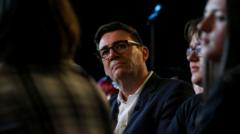
Andy Burnham ruled out holding a border poll on Irish reunification during his first visit to Northern Ireland as Labour leader, saying the government must prioritize immediate challenges facing the region. The Manchester mayor and newly elected UK Labour Party chief dismissed the prospect of a unity referendum, framing the decision as one focused on pragmatism over symbolic gestures.
"We need to fix the things right in front of us in the here and now," Burnham stated, signaling Labour's shift away from divisive constitutional questions that have dominated Northern Irish politics for decades. His comments reflect the party's broader strategy under new leadership, one that prioritizes bread-and-butter issues over reopening the constitutional settlement established by the Good Friday Agreement.
The timing of Burnham's intervention carries weight. A border poll on Irish reunification remains constitutionally possible under the Good Friday Agreement framework if the secretary of state judges that a majority in Northern Ireland would support a united Ireland. Burnham's preemptive stance demonstrates Labour's intent to avoid stoking sectarian tensions or constitutional disputes that could destabilize the devolved government at Stormont or complicate the UK's relationship with Dublin.
The decision also signals continuity with the previous Conservative government's reluctance to trigger such a referendum. However, Burnham's emphasis on immediate material needs, not constitutional niceties, suggests a reframing of Labour's approach. Rather than defending the Union on ideological grounds, Burnham grounds his position in addressing healthcare backlogs, economic stagnation, and infrastructure deficits that plague Northern Ireland.
This stance has particular resonance given ongoing challenges in Belfast and beyond. The National Health Service in Northern Ireland faces severe staffing shortages and waiting lists among the longest in the UK. Manufacturing and investment have stalled in recent years. Cross-community tensions, while reduced from historic peaks, remain fragile. Burnham's visit signals that Labour intends to treat Northern Ireland as a region requiring practical governance solutions rather than constitutional theater.
The move also reflects shifts within the broader UK political landscape. Scottish independence has cooled as a live issue under Keir Starmer's Labour government. Welsh devolution remains contentious but contained. By shutting down border poll speculation early, Burnham removes a potential flashpoint that could have complicated Labour's governing agenda across the four nations.
Burnham's framing also appeals to moderate unionists and nationalists alike who prioritize economic recovery over constitutional change. Polling data consistently shows that while identity questions remain deeply felt, voters across the board cite healthcare, jobs, and cost-of-living pressures as top concerns. His visit, the first by a Labour leader in this position to the region, positions the party as solution-focused rather than ideologically rigid.
The statement does leave room for future reconsideration if political conditions shift dramatically. But for now, Burnham has drawn a clear line. Labour intends to govern the United Kingdom as currently constituted, focus resources on material improvements, and sideline constitutional referenda from its immediate agenda.