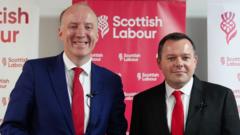
Michael Marra and Joe Fagan have entered the race to become Scottish Labour leader, positioning themselves as candidates to replace Anas Sarwar in what party insiders describe as one of Britain's most difficult political positions.
Sarwar announced his resignation in September 2024 after leading the Scottish Labour Party through a period of modest recovery. Under his tenure, Labour regained some ground in Scotland after years of SNP dominance, but the party remains third in Holyrood with limited leverage in Scottish politics. The leadership vacuum triggered multiple declarations of interest, with Marra and Fagan now formally throwing their names into contention.
Marra, the MSP for North East Scotland, represents a traditional Labour stronghold and brings constituency experience to the race. His pitch emphasizes reconnecting Labour with working-class voters in Scotland's northeast, a region where the party once held unshakeable control before the SNP surge of 2015. Fagan, representing Dumbarton, represents a similar narrative: rebuilding Labour's base in post-industrial communities that formed the party's traditional backbone.
The timing of this leadership election matters. The Scottish National Party under John Swinney controls Holyrood with a tenuous majority. Westminster Labour, led by Keir Starmer, sits in government with a substantial UK-wide mandate. This creates both pressure and opportunity for the Scottish Labour leader. The new leader must revitalize a party that polls suggest could make significant gains in the next Scottish Parliament election, currently scheduled for 2026.
Scottish Labour's structural challenges run deeper than personality. The party ranks behind both the SNP and the Scottish Conservatives in current Holyrood polling. Recovery requires not just leadership charisma but a credible policy platform, effective media operation, and reconnection with constituencies that switched to the SNP or abstained from voting altogether. The successful candidate must also navigate the complex relationship with Westminster Labour while maintaining distinct Scottish priorities.
Previous Labour leaders in Scotland have found the role punishing. Sarwar himself inherited a party in acute crisis, with Scottish Labour reduced to 22 MSPs at the 2021 election. He stabilized the party and added seats in by-elections, but broader recovery proved elusive. Jack McConnell's tenure as Labour leader effectively ended his Scottish political career. Iain Gray lost his seat during his time at the helm.
The leadership campaign will test whether either Marra or Fagan can articulate a vision distinct enough to attract soft SNP voters while reassuring the party's remaining core supporters. Scottish voters increasingly view Scottish politics through a devolution lens, prioritizing education, health, and local development over Westminster battles. The next Labour leader must reflect this reality.
The formal ballot process will determine when party members vote. Candidates need support from a threshold of party members or MSPs to qualify for the final ballot. The winner will inherit a party with real momentum but unfinished work: rebuilding trust in communities where Labour's brand eroded over a decade.