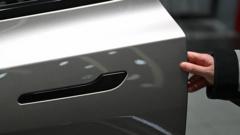
Tesla initiated a sweeping recall of nearly three million vehicles in China over a defective door handle mechanism that can fail without warning, leaving occupants potentially trapped inside vehicles. The recall affects multiple Tesla models operating in the Chinese market, the world's largest EV sector.
The Chinese government's market regulator identified a critical safety flaw in Tesla's hidden door handle design. The mechanism, which retracts flush into the vehicle's body for aerodynamic efficiency, can malfunction and prevent doors from opening. This represents one of the most serious design vulnerabilities Tesla has faced in its most profitable market outside the United States.
The scope extends beyond Tesla. Chinese electric vehicle manufacturers XPeng, Xiaomi, and Geely also received recall notices for similar hidden door handle failures. This suggests the design flaw runs deeper than Tesla's engineering alone. Multiple automakers adopted hidden door handles as a premium design feature tied to the sleek aesthetic of modern EVs. The simultaneous recalls indicate a systemic design problem across the industry rather than isolated Tesla quality control issues.
China's vehicle regulator has intensified scrutiny of Tesla following earlier safety investigations. Tesla recalled over one million vehicles in China in 2021 for acceleration control issues. That investigation raised questions about Tesla's brake and pedal systems. The latest recall demonstrates China remains willing to force major corrections from the American EV manufacturer despite Tesla's market dominance in the country.
Hidden door handles present engineering challenges that exposed carmakers to unforeseen failure modes. The motorized mechanism requires precise calibration and redundant safety systems. If the primary actuator fails, backup mechanisms must engage to allow manual door operation. Tesla's design apparently lacked adequate failsafes, according to the regulator's findings.
The recall creates logistical demands for Tesla's service network in China. Three million vehicles represent enormous capacity requirements. Tesla operates 300-plus service centers across China but faces bottlenecks in rural areas. The company must prioritize repairs based on vehicle age and usage patterns while maintaining customer satisfaction in a market where premium EV buyers expect rapid service resolutions.
The incident underscores how China's regulatory environment differs from North America's. The National Highway Traffic Safety Administration in the US operates on complaint-driven recalls rather than proactive government investigations. China's State Administration for Market Regulation initiates recalls independently when safety data surfaces. This approach accelerates corrections but also increases Tesla's operational complexity.
For competitors like BYD, which leads China's EV market by volume, the recall creates an opportunity. Safety-conscious buyers may shift allegiance to brands with fewer documented defects. XPeng and Li Auto have positioned themselves as Tesla alternatives emphasizing superior build quality. This recall reinforces that positioning among affluent Chinese consumers evaluating premium electric vehicles.
Tesla's stock responded to news of the recall with mild selling pressure, though the market viewed the recall as manageable rather than existential. The company generated roughly 1.3 million vehicle deliveries globally in 2023, meaning the Chinese recall affects roughly two years of production volume. CEO Elon Musk has indicated Tesla plans expanded manufacturing capacity in China despite regulatory headwinds.
The hidden door handle recall demonstrates that even dominant automakers face design vulnerability when scaling novel technology rapidly. The simultaneous failures across multiple manufacturers suggest industry-wide learning gaps in motorized door systems. Expect stricter testing protocols and redundancy requirements for hidden door handles across Chinese regulatory approvals going forward.