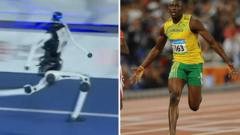
A humanoid robot sprinted 100 meters in 9.39 seconds at the World Humanoid Robot Games in Beijing, eclipsing Usain Bolt's world record of 9.58 seconds set in 2009. The feat marks a striking milestone in robotics engineering, though the comparison itself requires immediate context.
Bolt's record stands as the fastest time ever achieved by a human competitor under official Olympic conditions. The humanoid robot operated in a controlled environment at a specialized competition designed specifically to showcase machine capabilities. The robot's achievement reflects advances in servo motors, balance systems, and algorithmic stride optimization rather than a direct athletic comparison. Robots lack the biological constraints, fatigue responses, and decision-making pressures that define human athletic performance.
The World Humanoid Robot Games function as an engineering showcase rather than a traditional sports competition. Participating machines from universities and research institutions compete across multiple categories including walking, running, climbing, and problem-solving tasks. These events drive innovation in bipedal locomotion, weight distribution, and real-time response systems. The Beijing competition drew entries from robotics teams globally, each pushing the boundaries of what humanoid machines can physically execute.
Humanoid robot development has accelerated over the past decade. Major tech companies and research labs have invested heavily in bipedal design because humanoid form factors allow robots to operate in spaces designed for humans. Honda's ASIMO, Boston Dynamics' Atlas, and Tesla's Optimus represent different approaches to humanoid engineering. Each pursues distinct applications, from industrial automation to last-mile logistics. The 100-meter sprint appears less relevant to real-world deployment than stability on uneven terrain or dexterous manipulation, yet speed benchmarks capture public attention and funding momentum.
The 9.39-second run demonstrates real progress in mechanical engineering. Achieving sustainable bipedal running at that velocity requires solving multiple technical problems simultaneously. The robot must maintain balance during ground contact and flight phases, distribute impact forces across joints without damage, and generate sufficient hip and knee torque. Power systems must sustain output without overheating. Software must coordinate dozens of motor commands per second to prevent falls.
Bolt's human record remains contextually superior. Achieving 9.58 seconds required years of training, genetic predisposition, explosive muscle recruitment, and mental preparation. Bolt compressed his 100-meter run into optimal biomechanics honed through thousands of hours of work. He accelerated from stationary position and navigated wind resistance. The humanoid robot operated under engineered conditions optimized for its mechanical architecture.
The viral comparison trivializes both human and machine achievement. It fuels technological hype while underselling the genuine engineering breakthrough. Humanoid robotics matter not because machines will "beat" Olympians at their discipline, but because the underlying capabilities enable robots to interact effectively with human environments. A robot that runs smoothly also walks reliably, navigates stairs, and maintains balance during dynamic tasks. Those skills have commercial applications in inspection, rescue operations, and autonomous navigation.
The Beijing competition represents progress worth tracking. The moment belongs to the robotics engineers who solved bipedal running problems, not to the machine itself. The comparison to Bolt generates headlines but obscures the real story. Humanoid robots advance when they solve practical problems that matter in industrial and domestic settings. A 9.39-second sprint demonstrates motion capability. Practical deployment demands precision, reliability, and adaptability that remain unreached.