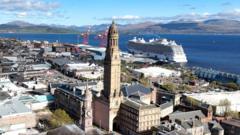
# Scottish Town Bets On Immigration To Reverse Decline
Greenock, a port town on Scotland's west coast, has adopted a strategy that runs counter to anti-immigration sentiment gripping much of the UK. The local council backs a deliberate campaign to attract migrants and settle them in the community, aiming to reverse decades of population loss.
The town's economy contracted sharply after its shipbuilding industry collapsed in the late 20th century. Manufacturing jobs vanished. Young people left for Glasgow and Edinburgh. Storefronts emptied. Today, Greenock's population sits well below historical peaks, leaving schools underenrolled, services underused, and commercial districts struggling to justify investment.
Council leaders view immigration not as a burden but as a lifeline. Migrants bring working-age bodies, entrepreneurial drive, and consumer spending. They fill vacancies in the labor market. They start businesses. They enroll children in schools that would otherwise close. They rent apartments and buy homes in a depressed property market. On purely economic grounds, a shrinking town cannot sustain itself.
This stance places Greenock at odds with broader political currents. Anti-immigration rhetoric dominates UK politics, particularly within the Conservative Party and among Leave voters in post-industrial towns. Councils and communities in former manufacturing hubs often voice resentment toward newcomers, framing immigration as a problem rather than a solution. Greenock's council rejects that frame entirely.
The council has begun practical work to welcome immigrants. It has partnered with organizations that support asylum seekers and refugees. It has improved integration services and language programs. It has signaled, through official channels, that migrants are wanted here.
The gamble faces real obstacles. Xenophobic sentiment exists in Greenock as elsewhere. Employment opportunities remain limited. Housing stock requires renovation. Services are stretched. But the council's calculation is straightforward: without new residents, decline becomes irreversible. With them, the town has a chance.
Greenock's approach offers a counter-narrative to dominant UK immigration discourse. It shows that communities can choose to see migrants as part of their future rather than a threat to it. Whether other struggling towns follow Greenock's lead remains unclear. The political climate works against such openness. But Greenock's council has concluded that the alternative to immigration is not stability or prosperity. It is slow death.