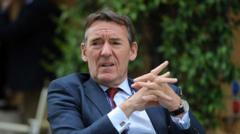
Lord O'Neill, the former Goldman Sachs chief economist and key architect of the "BRICS" framework, has ruled out taking a formal government role within Andy Burnham's administration. The move closes the door on speculation that he would become the Labour mayor of Greater Manchester's chief economic adviser.
O'Neill, who served as Goldman Sachs' head of economics before moving into advisory capacities, had been widely tipped for the position. His potential appointment would have signaled Burnham's intent to bring heavyweight economic expertise into the devolved Manchester leadership. The BRICS theorist, who gained prominence in the mid-2000s for coining the acronym describing the emerging economic powers of Brazil, Russia, India, and China, carries credibility in both financial circles and policy discussions.
The rejection carries implications for Burnham's economic agenda. Greater Manchester controls significant transport, regeneration, and business investment decisions under its devolved authority structure. An adviser of O'Neill's caliber would have shaped regional growth strategy, particularly around the post-pandemic recovery and the city region's positioning in a competitive British economy. His absence means Burnham must build his economic team from a different talent pool.
O'Neill's decision reflects the practical constraints of senior economist advisory roles. Holding a formal government position typically requires surrendering other consulting and speaking engagements, limiting independence and earning capacity. For someone of his standing, the trade-offs between full-time bureaucratic work and the flexibility of advisory consulting often tip toward the latter. He continues to hold positions at multiple think tanks and maintains a profile as a public commentator on economic policy.
The decision also occurs within a broader context of Labour's attempts to project economic competence after 14 years of Conservative governance. Burnham, one of the party's most prominent regional figures, has positioned Greater Manchester as a laboratory for Labour's economic vision outside Westminster. The mayor has championed devolution as essential to addressing regional inequality, leveling up opportunities in the North, and competing globally. Expert advisers with O'Neill's profile would underscore that ambition.
Burnham will now look elsewhere for his chief economic adviser. The role requires someone capable of advising on major decisions around business development, skills training, infrastructure investment, and regional competitiveness. Candidates might come from academia, the civil service, private sector consulting, or think tank leadership. The caliber of hire signals how seriously the mayor's office treats economic development.
O'Neill's decision illustrates the frequent gap between political ambition for high-profile appointments and the willingness of top economists to accept them. Formal positions carry constraints that advisory roles do not. His choice to remain outside formal government structures leaves him freer to pursue multiple engagements while maintaining the intellectual independence many senior figures prize.