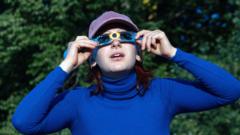
Staring at the sun during a solar eclipse without proper eye protection causes serious, sometimes permanent vision damage. The retina, the light-sensitive tissue at the back of the eye, absorbs intense solar radiation and burns within seconds.
Symptoms of eclipse-related eye injury appear quickly or within hours. Blurred vision ranks among the most common signs. Patients also report seeing dark or blank spots in their central vision, a condition called scotoma. Some experience wavy or distorted images. Pain, sensitivity to light, and trouble reading or recognizing faces follow in more acute cases.
The danger persists even when the moon covers most of the sun. During the partial and total phases, the sun's rays remain strong enough to cause permanent damage. Only during totality, when the moon completely blocks the sun's disk, is it safe to look without special glasses. That window lasts just minutes.
Eclipse glasses block 99.99 percent of the sun's light. Regular sunglasses offer zero protection. The damage happens silently. People feel no immediate pain because the retina has no pain receptors. By the time symptoms appear, the harm is done.
If you looked at the eclipse without protection, watch for vision changes over the next 24 to 48 hours. Blurred vision or dark spots warrant immediate eye care. An ophthalmologist can spot retinal burns using specialized imaging. Some damage reverses on its own, but severe burns cause lasting vision loss.
Prevention remains the only guarantee. NASA and the American Academy of Ophthalmology recommend ISO 12312-2 certified eclipse glasses. These filter out ultraviolet and infrared rays that cause the internal burning.