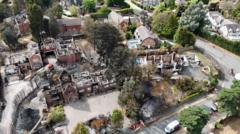
Firefighters across England and Wales face mounting operational strain as multiple major incidents unfold simultaneously. Blazes in Stourbridge, Sandwell, and Pershore have forced authorities to activate emergency protocols, stretching response capabilities and personnel across the region.
Fire chiefs characterize the current situation as placing crews under "incredible pressure." The declaration of major incidents across multiple locations signals the severity of these fires and the coordination challenges facing emergency services. When authorities classify an incident as "major," it triggers coordinated emergency response protocols involving mutual aid between fire services, police liaison, and often military or specialized rescue units.
The three locations represent a geographic spread that compounds the pressure on the service. Stourbridge and Sandwell sit in the West Midlands conurbation, while Pershore sits further south in Worcestershire. This distribution limits the ability to quickly redeploy resources between sites, as crews committed to one location cannot rapidly assist at another.
The timing of concurrent major incidents reveals vulnerabilities in emergency service staffing and resilience planning. While the UK fire service operates on a model combining full-time and retained firefighters, peak operational demands can exhaust rotas quickly. Multi-site emergencies force commanders to draw personnel from lower-priority calls, potentially leaving other areas with reduced cover.
Fire services across the UK have faced staffing challenges in recent years. Budget constraints at local authority level have led to station closures and frozen recruitment in some regions. These structural pressures become acute when incidents cluster. A single major fire demands extensive resources. Multiple simultaneous major incidents can overwhelm pre-positioned mutual aid arrangements.
The specific nature of the fires, whether structural blazes, industrial fires, or vegetation incidents, determines resource requirements. Larger commercial or multi-story residential fires demand aerial platforms, water carriers, and specialized teams. The more incidents declared as "major," the faster specialized equipment becomes exhausted across the regional network.
Local government and emergency planning authorities face pressure to justify operational readiness investments. Fire chiefs use moments like this to highlight resourcing gaps and argue for additional funding. Their public statements about "incredible pressure" serve both as operational assessment and as advocacy for improved capacity.
The incidents also test incident command structures. Multiple major incidents require clear command hierarchies, communication protocols, and liaison with other emergency services. Police manage cordons and public safety perimeters. Ambulance services establish triage and transport. Local authorities activate rest centers for displaced residents.
For communities affected by these fires, the declaration of major incident status brings both operational benefits and acknowledgment of severity. Enhanced resources flow to affected areas. But it also signals that authorities view the situation as beyond standard response capacity. Residents and businesses in Stourbridge, Sandwell, and Pershore face disruption while crews manage what fire services describe as an exceptionally demanding operational period.
The incidents underscore how rapidly fire service capacity can become strained when geographic clustering occurs. Preparation for such scenarios occurs continuously through training and mutual aid agreements, but actual deployment tests systems in ways planned exercises cannot fully replicate.