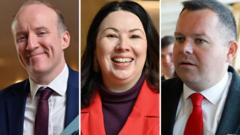
Scottish Labour faces a critical inflection point as three candidates publicly position themselves to inherit a party grappling with internal fractures and declining electoral relevance north of the border.
Monica Lennon, Joe Fagan, and Michael Marra are the frontrunners vying for leadership following Anas Sarwar's departure. Each contender has identified party unity as a central campaign theme, a tacit acknowledgment that Scottish Labour currently operates as a fractured organization struggling to reclaim ground lost to the Scottish National Party over the past two decades.
Lennon, a prominent MSP and former parliamentary candidate for Westminster, brings profile and visibility. Her emphasis on avoiding further division signals awareness that Scottish Labour cannot afford internal bloodletting while the SNP dominates Holyrood and Westminster representation from Scotland. The party has hemorrhaged seats and voter trust since the independence referendum of 2014, when many traditional Labour supporters defected to the SNP on constitutional grounds and populist appeal.
Fagan represents the union-backed establishment wing. His framing of anti-division messaging carries weight within Labour circles where organizational discipline historically drove electoral performance. The trade union movement remains Scottish Labour's institutional backbone, and Fagan's candidacy likely appeals to affiliated membership blocs seeking continuity and strategic consolidation rather than radical repositioning.
Marra, the third contender, offers a fresh-faced alternative positioned between establishment and insurgency. His warnings against party divisions function as a pre-emptive strike against the factionalism that has plagued Scottish politics broadly. The SNP's internal troubles in 2023 and 2024, including the tumultuous departure of Nicola Sturgeon and John Swinney's brief tenure as First Minister, demonstrated how quickly dominance can erode when leadership becomes toxic.
Scottish Labour's strategic problem runs deeper than leadership selection. The party holds just one Westminster seat currently, down from 41 in 2015. Holyrood representation hovers around 22 seats in a 129-member parliament. These numbers reflect not temporary setback but structural realignment of Scottish politics around independence versus union identity markers rather than traditional left-right economics.
All three candidates must navigate this reality. Whichever leadership emerges from this contest inherits a party with limited room for error. The 2026 Holyrood election represents the next major test. Scottish voters demonstrated in 2024 general elections that independence fatigue runs real and that center-left unionism remains viable messaging. Labour's UK majority under Keir Starmer creates tailwinds for Scottish party revival, but only if internal cohesion allows strategic messaging to land without drowning out conflicting voices.
The warning rhetoric all three candidates deploy speaks to recent history. Scottish Labour tore itself apart through leadership instability and factional infighting in the 2010s. The party cannot repeat that cycle and survive.