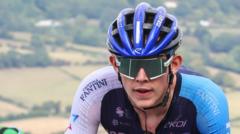
Finlay Tarling, a 19-year-old British cyclist, died in a crash during the eighth stage of the Volta a Portugal on Thursday. The accident occurred during one of Europe's most demanding professional cycling races.
Tarling competed for Alpecin-Deceuninck, a WorldTour team based in Belgium. He was a rising talent in the professional peloton, having turned pro recently and securing a spot on a top-tier roster. The Volta a Portugal ranks among the continent's most prestigious stage races, attracting elite cyclists preparing for major summer competitions.
Details surrounding the crash remain limited, but stage racing accidents happen with regularity in professional cycling. The sport demands extreme concentration at high speeds, often on narrow roads with challenging terrain. A single mechanical failure, lapse in attention, or collision between riders can prove catastrophic. The Volta's demanding mountainous stages push riders to their physical limits.
Tarling's death marks another tragic loss in professional cycling. The sport has experienced several fatal accidents over the past decade, including the deaths of Spanish rider Juan Manuel Molina in 2020 and Belgian cyclist Bjorg Lambrecht in 2019. These incidents have reignited debates about rider safety, course design, and emergency protocols at major races.
Alpecin-Deceuninck released a statement expressing grief over the loss of their young teammate. The team had invested in Tarling's development as part of their long-term roster strategy. His emergence into the professional ranks represented the kind of fresh British talent that has gained traction in recent years, following the success of cyclists like Tom Pidcock and Geraint Thomas.
The British Cycling federation and international cycling authorities typically investigate serious accidents during sanctioned events. The Union Cycliste Internationale, which oversees the sport globally, works with race organizers to review courses and safety measures after fatal incidents.
Professional cycling has instituted various safety measures over recent years, including mandatory helmet use, medical response protocols, and course restrictions that limit speeds on particularly dangerous descents. However, the inherent risks of racing at 50-plus kilometers per hour while navigating tight formations remain present.
Tarling's death will reverberate through the cycling community as teams, riders, and fans process the loss. The Volta a Portugal may face increased scrutiny over the accident's circumstances. The tragedy underscores how quickly professional cycling can shift from athletic achievement to personal loss, affecting not just teammates and family but the entire sport.