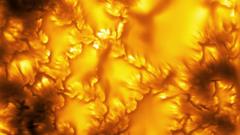
The Solar Orbiter spacecraft has captured unprecedented close-up imagery of the Sun, revealing intricate patterns of magnetic activity invisible to previous observation methods. The European Space Agency and NASA collaboration has produced the most detailed solar surface images to date, exposing dynamic "whirlpools" of plasma and convective currents that fundamentally reshape scientific understanding of solar behavior.
These images represent a watershed moment in heliophysics. The orbiter's advanced instrumentation penetrates atmospheric layers with resolution that transforms theoretical models into observable reality. Researchers now witness real-time solar convection patterns, magnetic reconnection events, and plasma dynamics at scales previously theoretical.
The mission captures the Sun during its active phase of the 11-year solar cycle, a timing that amplifies the scientific payoff. Solar activity directly impacts Earth's magnetosphere, power grids, satellite communications, and space weather prediction. Understanding these "whirlpools" provides critical data for forecasting solar flares and coronal mass ejections that threaten infrastructure and astronauts in orbit.
The Solar Orbiter's trajectory positions it between Earth and the Sun, offering viewing angles impossible from ground-based observatories or Earth-orbit satellites. Its heat shield protects sensitive instruments while operating closer to the solar surface than ever before. Each image set generates terabytes of data that scientists will analyze for years, unlocking secrets about solar magnetism and dynamics.
This breakthrough validates decades of mission planning and engineering. Future solar missions will build on these findings, pushing closer and capturing even sharper details. The imagery already influences how space agencies plan radiation protection for crewed missions to Mars and deep space.
For the general public, these images offer visceral proof of the violent, beautiful complexity churning beneath the Sun's photosphere. The whirlpools remind us that our nearest star remains fundamentally dynamic and worthy of relentless study.