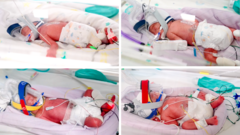
Identical quadruplets born naturally in Australia represent an exceptionally rare medical event. The four girls arrived without fertility treatment or medical intervention, a statistical anomaly that occurs in roughly one in 15 million pregnancies worldwide.
The parents experienced what the hospital termed "immense surprise" upon learning they were expecting four children instead of one. Natural identical multiples form when a single fertilized egg spontaneously splits, a process that compounds in probability with each additional division. Quadruplets from this mechanism, without assisted reproduction, ranks among obstetric rarities.
Most multiple births result from fraternal twins or fertility treatments that increase ovulation. Identical multiples from natural conception happen infrequently enough that medical literature documents each case. Hospitals track these births because they carry higher risks for complications including twin-to-twin transfusion syndrome, where blood vessels connect between fetuses and create imbalances in fluid and nutrient distribution.
The Australian hospital's announcement signals a successful outcome for both mother and children, a necessary condition for public reporting. Pregnancies involving quadruplets, identical or otherwise, demand intensive prenatal monitoring and specialized delivery protocols. The survival and health of all four infants represents a medical success story in a high-risk scenario.
This birth adds to a small global registry of naturally conceived identical multiples. Australia has reported identical multiples before, but quadruplets remain statistically remarkable. The event underscores the unpredictability of human reproduction and the biological mechanisms that remain incompletely understood by modern medicine. Families experiencing such outcomes become part of medical history, their cases reviewed by researchers studying the mechanisms behind spontaneous embryo splitting.