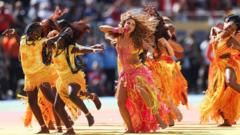
The 2022 FIFA World Cup halftime show delivered a star-studded lineup that spanned decades of pop dominance. Shakira, Madonna, Justin Bieber, and BTS took the stage alongside Robbie Williams and Jennifer Hudson in a performance designed to reflect global music tastes ahead of the tournament's final matches.
Shakira and Madonna brought arena-rock swagger to the spectacle, with the Colombian artist's signature hip-movement choreography and the pop icon's enduring stage presence commanding attention. Their performances underscored FIFA's strategy of booking acts with multigenerational appeal and international reach. Justin Bieber, whose streaming numbers remain massive across Latin America and Asia, paired with BTS to pull younger audiences. The K-pop group's inclusion marked a watershed moment for Asian artists in one of sports' most-watched broadcasts, signaling how streaming power now shapes entertainment decisions at this scale.
Robbie Williams, a veteran of stadium shows, and Hudson, whose voice delivered technical precision, rounded out a lineup that prioritized proven performers over viral moments. The broadcast featured celebrity attendance from Kylie Jenner and Timothee Chalamet, amplifying social-media reach across Gen Z and millennial demographics.
The halftime show's construction reflected post-pandemic touring economics. Rather than coordinating one artist's full production, the World Cup assembled modular performances that allowed each act limited stage time but maximum promotional value. Shakira and Madonna had already dominated streaming charts; BTS and Bieber brought younger listener bases. This fragmentation mirrors how modern pop festivals and awards shows now operate, prioritizing roster depth over artistic coherence.
For streaming platforms, the halftime exposure translates directly to playlist placement and algorithm visibility. The broadcast audience numbered in the billions, making it one of music's few remaining mass-audience moments. Each artist's catalog benefited from the synchronized global attention that traditional radio once provided.