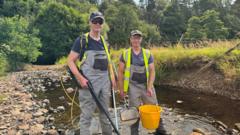
The West Cumbria Rivers Trust has launched a restoration project targeting the European eel, a species whose population has collapsed by 90 percent over three decades. The initiative focuses on removing barriers in rivers across northwest England that prevent eels from migrating upstream to spawning grounds.
European eels undertake one of nature's most grueling journeys, traveling thousands of miles from the Sargasso Sea to European freshwater systems where they mature. Young eels, called elvers, must navigate river systems to reach suitable habitat. Dams, weirs, and other man-made obstructions block these critical pathways, trapping populations and preventing reproduction cycles.
The dramatic population decline stems from multiple threats. Habitat fragmentation ranks foremost, but overfishing, parasites, and pollution compound the problem. Commercial eel fishing, particularly in their marine phase, has devastated wild stocks across Europe. The trust's work aims to restore connectivity by either removing physical barriers entirely or installing fish passes that allow eels to bypass obstacles.
Rivers across Cumbria serve as migration corridors. By clearing pathways, the project restores access to spawning habitat and allows populations to recover naturally. This follows similar conservation efforts across Europe, where eel restoration has become a conservation priority under EU environmental directives.
The trust's intervention addresses a species on the International Union for Conservation of Nature's critically endangered list. Without action, European eels face local extinction in many regions. The project demonstrates how habitat restoration and infrastructure modification can reverse population collapse for highly migratory species. Success depends on coordinated efforts across multiple river systems, as eels' life cycle spans continental distances. Restoring these pathways offers hope for stabilizing a species pushed to the brink by human development.