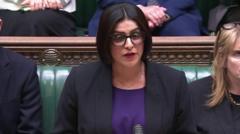
Britain's Justice Secretary Shabana Mahmood announced a ban on support for Iran's Islamic Revolutionary Guard Corps (IRGC), leveraging fresh legislative powers to target the paramilitary organization. The move addresses documented instances of death threats and intimidation operations conducted within UK territory.
Mahmood's action marks an escalation in Britain's stance toward the IRGC, a military force answerable directly to Iran's Supreme Leader. The ban prohibits material support, fundraising, and recruitment activities on British soil. It expands existing restrictions that already listed the IRGC as a terrorist organization in specific operational contexts.
The timing reflects growing concerns over Iranian intelligence operations in the UK. Security services have documented cases where the IRGC and affiliated units targeted dissidents, journalists, and political opponents residing in Britain. Recent years have seen multiple prosecutions of individuals accused of conducting surveillance and intimidation campaigns on behalf of Iranian state entities.
Mahmood framed the action as a defense of national security and public safety. The ban grants authorities broader investigative and prosecutorial tools to dismantle support networks that facilitate IRGC activities. Individuals caught providing material assistance face potential criminal penalties.
The decision aligns Britain with other Western nations that have designated the IRGC as a terrorist entity or its equivalent. The European Union maintains sanctions against the organization linked to regional military operations and human rights violations. The United States designated the IRGC's Quds Force as a foreign terrorist organization in 2019.
Britain's law enforcement and counterintelligence agencies, including MI5, have intensified monitoring of Iranian state-sponsored activity. The ban consolidates these enforcement efforts into a single comprehensive prohibition that covers virtually all forms of institutional support and association.